ZF is merging its hardware expertise with advanced software and artificial intelligence to deliver future-ready mobility solutions. At CES 2026, ZF is introducing “AI Smart Road Sensing,” an AI-based software solution that predicts road conditions and driver behavior to enhance safety and comfort. Additionally, ZF is setting new standards in chassis acoustics with its “Active Noise Reduction” technology, significantly reducing tire noise within the vehicle cabin.
The Software-Defined Vehicle (SDV) has transitioned from a concept to a reality. Building on foundational technologies like steer-by-wire and brake-by-wire, ZF is defining new standards in chassis innovation with software products that offer brand-specific driving experiences while improving safety. As part of its Chassis 2.0 strategy—which integrates smart hardware, AI, and software—ZF is debuting two major innovations at CES 2026: AI Smart Road Sensing and Active Noise Reduction.
Dr. Peter Holdmann, Member of the ZF Board of Management and Head of the Chassis Solutions Division, stated: “With our Chassis 2.0 strategy, we are leading the transformation of the chassis in the digital age. By combining hardware expertise and advanced software with AI, we are creating solutions that elevate safety and comfort to a new level. We are shaping the future of mobility with intelligent, connected, and scalable solutions.”
AI Smart Road Sensing: Predicting the Path Ahead

ZF’s AI Smart Road Sensing is an innovative, AI-based solution designed to increase safety and comfort. Using state-of-the-art sensors, the system adapts the chassis in real-time to changes in the road surface—whether in winter conditions, off-road environments, or transitions between different terrains.
This data is processed by ZF’s cubiX chassis software to control intelligent actuators, such as the Continuous Damping Control (CDC) semi-active suspension or the sMOTION active suspension system.
-
Rapid Response: sMOTION reacts within 1 millisecond to adjust dampers.
-
Integrated Safety: In the future, this integration will extend to steering and braking systems for advanced control.
-
Reliable Confidence: The system detects specific situations within milliseconds—faster than human reflexes—ensuring the vehicle’s behavior consistently meets driver expectations.
The system is scalable and offered in three versions:
-
Standard: Uses CAN bus signals to determine road conditions.
-
Advanced: Adds camera data to pre-analyze and analyze the road surface.
-
Premium: Incorporates LiDAR technology to scan the road profile 25 meters ahead with 2-centimeter precision, creating a detailed 3D road map for precise chassis adjustments.
Intelligent Adaptation: Distinguishing Snow from Pavement
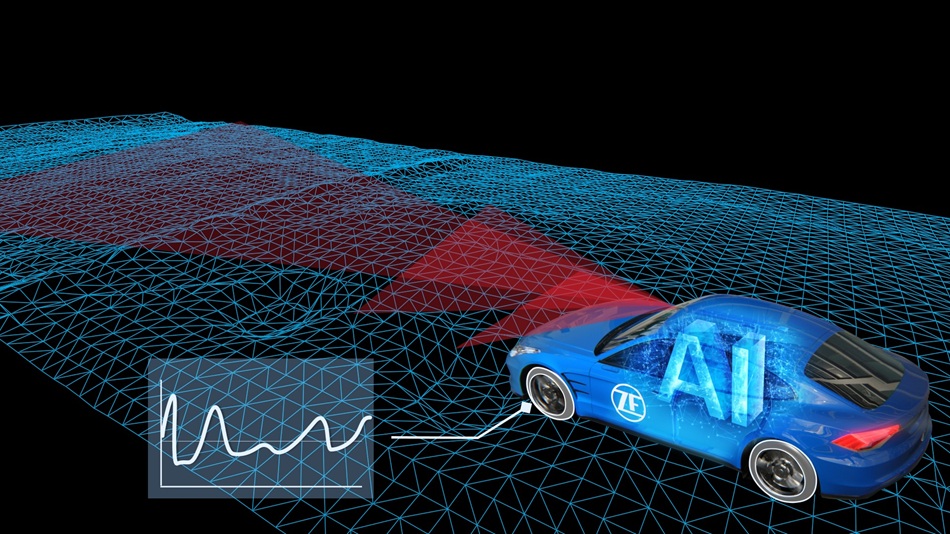
ZF’s system expertise shines in its ability to fuse sensor and chassis data. While a camera might see snow simply as a uniform surface, ZF combines camera signals with chassis data—such as tire slip and torque—to distinguish between deep and shallow snow.
-
Snow Launch: When a slippery road is detected, the system automatically engages a low-torque start to prevent wheel spin.
-
Off-Road Intelligence: In mud, sand, or rocks, the AI automatically selects the optimal driving strategy, pre-locking differentials even before the vehicle enters deep ruts.
-
Seamless Efficiency: On highways, the system instantly switches to a quiet, energy-saving mode without any driver intervention.
Active Noise Reduction: The Future of Cabin Silence
ZF is also debuting its Active Noise Reduction (ANR) software, which minimizes “tire cavity” hum without requiring additional damping hardware like microphones or speakers.
-
Pure Software: The system uses ZF’s Next-Generation Smart Chassis Sensors and cubiX software to analyze vibrations.
-
Anti-Noise Micro-Movements: The software generates a counter-signal via the CDC semi-active damper valves. These micro-adjustments neutralize vibration noise at the source.
-
Results: Currently achieves a reduction of over 3 dB, with potential for up to 10 dB in the future.
-
Production: Scheduled for series production in 2028, this innovation will be adaptable to all vehicle types.